

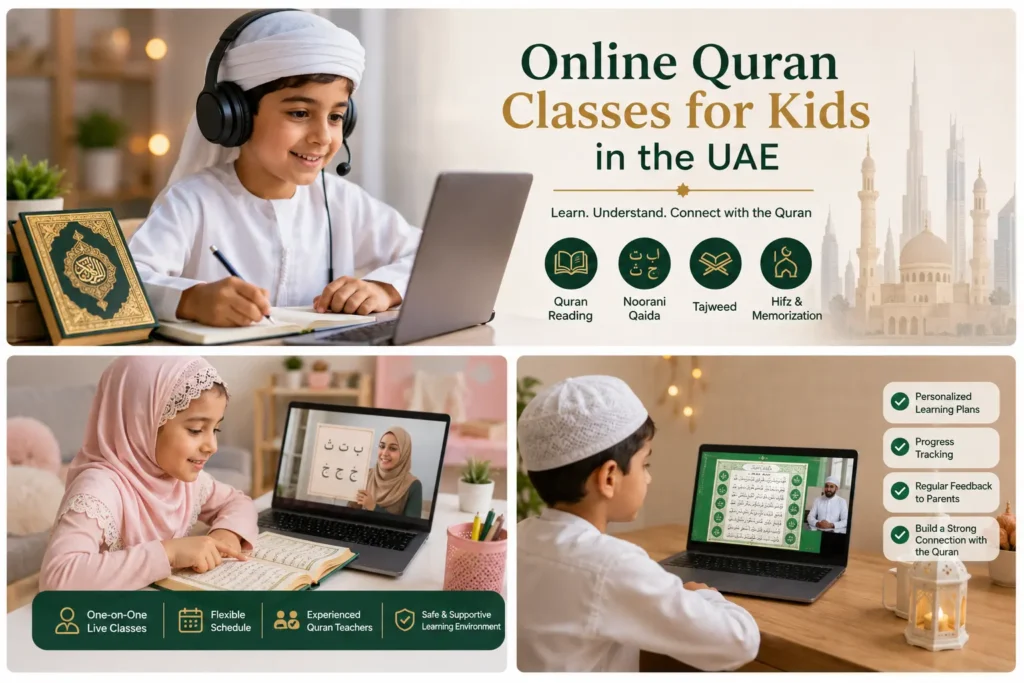
Online Quran classes for kids UAE are live lessons that help children learn Quran reading, Noorani Qaida, Tajweed, recitation, and memorization according to their age, level, and learning goals. One-on-one classes give children direct interaction with a tutor while allowing families to arrange lessons around school and other commitments.
For many families, choosing Quran education is about more than finding a convenient class. Parents naturally want to know who will teach their child, whether the lessons will be understandable and engaging, and whether an online format will fit comfortably into family life. Some children may already attend a mosque or Islamic center and simply need additional individual practice, while others may be looking for an accessible alternative because a suitable local teacher or schedule is difficult to find.
Online learning can provide that flexibility without suggesting that it replaces the value of in-person Islamic education. The right choice depends on the child’s age, starting level, learning goals, personality, schedule, and the quality of the teaching relationship. A thoughtful trial class can help families make that decision with greater confidence.
What Are Online Quran Classes for Kids UAE?
Online Quran classes for kids in the UAE are live lessons in which children study Quran reading, recitation, Tajweed, memorization, or related Islamic subjects with a tutor through an online learning platform. The exact curriculum depends on the child’s current ability and what the family hopes to accomplish.
A child who is new to Quran reading may begin with Noorani Qaida, a foundational resource used to develop familiarity with Arabic letters, sounds, and basic reading patterns. As reading develops, lessons can move toward Quran recitation and Tajweed, the rules governing correct Quran pronunciation and recitation.
Children who already read Quran may instead need more focused Tajweed practice or a structured Hifz, or Quran memorization, program. Islamic Studies and Arabic can also form part of a broader learning plan where appropriate.
One advantage of an online setting is that lessons can be delivered from home. This can be particularly practical for families managing school, homework, extracurricular activities, and other commitments. It also allows parents to consider tutors beyond those immediately available in their neighborhood.
The important question is not simply whether a class is online, but whether its teaching approach, tutor, schedule, and level of individual attention are suitable for the child.

What Does a Child Learn in an Online Quran Class?
A child’s Quran curriculum depends on their starting level and learning goals, but lessons may progress from Noorani Qaida and basic Quran reading to accurate recitation, Tajweed, memorization, and more advanced study.
Noorani Qaida and Quran Reading
Beginners generally need to establish the foundations before being expected to read longer passages independently. Lessons may therefore work on recognizing Arabic letters, connecting them, understanding vowel sounds, and practicing pronunciation. A child who cannot yet read Quran should not be treated as though they have the same needs as an experienced reader.
Quran Recitation and Tajweed
For children who can already read, the focus may shift toward improving recitation. During a live lesson, the tutor can listen as the child reads, identify areas that need attention, demonstrate a correction, and allow the child to practice it.
Tajweed study can become increasingly detailed as the learner develops. Rather than overwhelming a young student with terminology, a good teaching approach introduces appropriate concepts progressively and gives the child opportunities to apply them while reading.
Quran Memorization and Hifz
Children interested in memorization can follow a structured Hifz program involving new memorization and revision. The appropriate amount of material varies from one student to another, so responsible teaching should not promise that every child will memorize a particular amount within a fixed period.
How Are Quran Lessons Taught to Children Online?
Online Quran lessons typically take place as live, interactive sessions in which the tutor teaches, listens to the child’s reading or recitation, corrects mistakes, and adapts activities to the student’s level.
One-on-one instruction can be particularly useful when a child benefits from direct attention. Instead of waiting for a turn in a large group, the student can read directly to the tutor and receive immediate feedback. The tutor can also adjust explanations when a particular concept is difficult or move forward when the child is ready.
A practical online lesson may involve reviewing previous work, introducing a new reading or Tajweed concept, listening to recitation, correcting pronunciation, and assigning material for continued practice. The exact structure will naturally differ according to age and course.
Parents also have an important but relatively simple role. A quiet place, reliable internet connection, suitable device, and consistent lesson routine can make online study easier. Parents do not necessarily need to teach the material themselves; their role can instead be to support attendance, encourage practice, and communicate useful information about the child’s needs.
For younger children especially, the learning environment matters. A lesson scheduled when a child is tired or distracted may be less productive than one placed at a realistic time when the child can participate attentively.
How Can Parents Choose a Qualified Online Quran Teacher for Their Child?
Parents should look for a Quran tutor with relevant qualifications, teaching experience, clear communication skills, and an approach appropriate for children rather than choosing solely on price or availability.
A tutor’s Quran and Tajweed knowledge is an important starting point, but parents can also consider whether the teacher knows how to communicate with children patiently and clearly. Teaching a young beginner is different from teaching an advanced student, so age-appropriate communication matters.
Relevant certification should be clearly explained rather than presented through vague claims. For students pursuing Ijazah, parents should understand what the particular program involves and whether a qualified Sheikh and appropriate Sanad, or chain of transmission, are part of that pathway where applicable.
Tutor preference can also matter to a family. Rattil Online has both male and female tutors, allowing parents to discuss their preference when arranging classes, subject to availability.
Rattil Online brings more than 10 years of experience in online Islamic education and a team of 15+ qualified/certified tutors, including native Arab tutors. These details provide useful context when evaluating the academy, but a trial class remains valuable because credentials alone cannot determine whether a particular tutor is a comfortable fit for an individual child.
Is Online Quran Learning as Effective as Learning In Person?
Online Quran learning and in-person Quran learning each have different advantages, so suitability depends on the child’s learning style, family circumstances, teacher quality, and consistency rather than the format alone.
A local mosque, Islamic center, or qualified teacher can offer something valuable that an online class cannot fully reproduce: physical community interaction and an in-person learning environment. Families who already have a trusted local option may therefore choose to continue it.
Online classes offer different practical advantages. There is no commute, tutor selection does not have to be limited to the family’s immediate area, and one-on-one lessons can provide individual attention. These factors may be especially useful when a local teacher’s schedule does not work for the family or when parents are looking for a particular teaching arrangement.
| Consideration | Online Learning | In-Person Learning |
| Scheduling | Often more flexible | Depends on local availability |
| Tutor choice | May provide a broader choice | Usually tied to local options |
| Individual attention | One-on-one options available | Depends on class format |
| Travel | No travel required | Requires transportation |
| Learning environment | Home-based | Physical classroom |
| Community interaction | More limited | Direct physical interaction |
The better choice is therefore the one that genuinely works for the child’s needs rather than the one that sounds preferable in general.
Can Quran Classes Fit Around a Child’s UAE School Schedule?
Online Quran classes can fit around a child’s UAE school day, homework, extracurricular activities, and family commitments when the selected lesson time works for both the family and tutor.
For school-age children, after-school lessons may be convenient, but the earliest possible time is not always the best one. A child who has just completed a demanding school day may need time to eat, rest, or finish homework before concentrating on Quran study.
Weekend classes can be another practical option for families whose weekday schedules are crowded. What matters most is choosing a realistic routine that the child can maintain comfortably rather than creating an unnecessarily demanding timetable.
UAE families should also confirm lesson times in UAE local time before enrolling, particularly when tutor availability involves different locations or time zones. Clear scheduling helps prevent avoidable confusion and makes regular attendance easier.
Parents can also consider the child’s other activities when planning lessons. A schedule that leaves reasonable space for schoolwork, family life, recreation, and rest is generally more sustainable than filling every available hour.
For families already using a local mosque or Islamic center, online lessons can also complement existing education rather than replacing it. The purpose may simply be to provide additional individual practice, a different schedule, or access to a tutor whose teaching approach suits the child.
How Much Do Online Quran Classes for Kids Cost in the UAE?
The cost of online Quran classes for children in the UAE depends on factors such as lesson duration, number of classes, course type, student level, and whether lessons are one-on-one or group-based.
Parents comparing prices should first establish what each program actually includes. Two classes with different prices may also differ in lesson length, weekly frequency, tutor arrangement, or level of individual attention.
For example, Quran Reading for a beginner may have different requirements from a structured Tajweed or Hifz program. One-on-one teaching also provides a different learning format from a group class. The child’s current level can affect how the curriculum is organized as well.
Price is therefore only one part of the comparison. Parents can also ask:
- What qualifications and experience does the tutor have?
- How long is each lesson?
- How many lessons are included each week?
- Is the class individual or group-based?
- Can the family request a male or female tutor?
- How flexible is the schedule?
- What happens if the child needs a different level or course later?
Rattil Online’s free trial can give parents an opportunity to assess the class before making a longer-term decision. Families should have enough information about the actual course and fees to make a comparison that fits their circumstances rather than choosing based on a headline price alone.

How Can a Child Start Online Quran Learning With Rattil Online?
A child can begin online Quran learning by identifying their current reading level and goals, discussing tutor and scheduling preferences, and using a free trial to decide whether the class is a suitable fit.
The process can be straightforward:
- Identify the child’s level. Determine whether the child is a complete beginner, already reads Quran, or needs help with Tajweed or memorization.
- Clarify the goal. The family may be looking for Quran reading, Tajweed, Hifz, Islamic Studies, or another course.
- Consider tutor preferences. Families can discuss whether a male or female tutor would be preferable.
- Choose a practical schedule. Consider school, homework, activities, rest, and family commitments.
- Attend the free trial. Use the session to observe the teaching relationship rather than treating enrollment as an obligation.
- Evaluate the fit. Consider the child’s comfort, the tutor’s communication, the lesson structure, and the practicality of the schedule.
A free trial is particularly useful because parents can observe how the tutor speaks to their child and how the child responds. Is the explanation understandable? Does the tutor listen carefully? Are corrections respectful and clear? Does the child participate comfortably?
These observations can be more meaningful than choosing an academy from a list of generic promises. If the class feels suitable, the family can then decide whether regular lessons make sense.
Read also: Learn Quran Classes for Ladies
Why Choose a Thoughtful Approach to Online Quran Education?
A thoughtful approach to online Quran education starts with the child’s actual needs rather than with promises about speed or predetermined results. Families should look for qualified teaching, an appropriate curriculum, respectful communication, and a schedule that can realistically become part of everyday life.
Rattil Online has spent more than 10 years providing online Quran and Islamic education and works with more than 15 qualified/certified tutors, including native Arab male and female teachers. Its course offering includes Quran Reading, Tajweed, Hifz, Ijazah, Arabic, and Islamic Studies, allowing students to pursue different learning goals as their needs develop.
That range is useful, but choosing an academy remains a personal decision. A parent should feel comfortable asking about tutor qualifications, teaching methods, lesson frequency, course expectations, and scheduling before enrolling.
For UAE families, online learning can be a practical option when flexibility or tutor availability matters. It can also sit alongside existing mosque, Islamic-center, or community education where that arrangement works well. What matters is creating a learning experience that respects the child’s pace and supports steady engagement without unnecessary pressure.
Read also: Online Quran Classes UAE for Adults

Conclusion
Online Quran classes for kids in the UAE can provide a flexible way for children to study Quran reading, Noorani Qaida, Tajweed, recitation, and Hifz from home. The format can be particularly practical for families balancing UAE school schedules, homework, extracurricular activities, and other commitments, while still allowing direct interaction with a Quran tutor.
Choosing the right program requires more than comparing prices. Parents should consider tutor qualifications, experience with children, teaching style, male or female tutor availability, class structure, scheduling, and whether the course matches the child’s current level. A local mosque or Islamic center may remain an excellent choice for families with suitable access, while online learning can complement or provide an alternative when circumstances call for it.
Rattil Online offers more than 10 years of experience, a team of 15+ qualified/certified tutors, native Arab tutors, and male and female teachers. A free trial class provides a practical opportunity to see how the teaching approach works for a particular child before making a decision.
Frequently Asked Questions
Are online Quran classes suitable for kids in the UAE?
Online Quran classes can suit children in the UAE when the tutor, lesson format, schedule, and learning environment match the child's needs. Live one-on-one lessons can provide direct interaction and individual attention. Parents should consider the child's age, concentration, learning style, starting level, and existing Quran education.
What can my child learn in online Quran classes?
Online Quran classes can cover Noorani Qaida, Quran reading, recitation, Tajweed, and Quran memorization. The appropriate course depends on the child's ability and goals. Islamic Studies and Arabic may also be available as separate courses, allowing families to address different areas of Islamic education through structured online learning.
Can a complete beginner start Quran classes online?
A complete beginner can start Quran classes online with foundational instruction such as Noorani Qaida. Beginner lessons can introduce Arabic letters, sounds, pronunciation, and basic reading before progressing toward Quran recitation. The tutor should first understand the child's starting level and adapt instruction accordingly rather than assuming prior Quran-reading experience.
Are online Quran tutors qualified to teach children?
Qualified online Quran tutors should have relevant Quran or Tajweed knowledge, appropriate certification, and the ability to communicate effectively with children. Rattil Online provides access to certified native Arab tutors, with male and female teachers available. A free trial can also help parents assess whether a particular tutor suits their child.
Can I choose a male or female Quran teacher for my child?
Parents can consider whether a male or female Quran teacher is more comfortable for their family. Rattil Online has both male and female tutors, allowing families to communicate their preference when arranging classes, subject to tutor availability and scheduling. Tutor suitability and teaching approach should also be considered alongside gender preference.
How much do online Quran classes for kids cost in the UAE?
The cost of online Quran classes for kids in the UAE varies according to lesson frequency, duration, course type, student level, and class format. One-on-one and group lessons may have different fees. Parents should compare tutor qualifications, teaching structure, flexibility, and course suitability rather than selecting a program based on price alone.
Can online Quran classes fit around UAE school hours?
Online Quran classes can fit around UAE school hours when suitable lesson times are available. Families can consider after-school or weekend sessions while allowing time for homework, extracurricular activities, rest, and family commitments. A consistent schedule that allows the child to participate attentively is generally more practical than simply choosing the earliest available lesson.
Is online Quran learning better than learning at a mosque or Islamic center?
Online Quran learning is not universally better than learning at a mosque or Islamic center. Each format offers different benefits. Online classes may provide flexible scheduling and broader tutor choice, while in-person settings can provide physical classroom interaction and community connection. Families can choose either option or use both according to their circumstances.
How can I try Quran classes before enrolling my child?
Parents can use a free trial class to evaluate whether an online Quran program suits their child. During a free trial, parents can observe the tutor's communication, lesson structure, Quran instruction, and interaction with the child. The experience can help the family decide whether the tutor, course, and schedule feel appropriate before continuing.
How can I enroll my child in online Quran classes with Rattil Online?
Parents can begin enrollment with Rattil Online by contacting the academy through its website contact form or WhatsApp and arranging a free trial class. The trial can be used to discuss the child's current level, learning goals, tutor preferences, and scheduling needs before the family decides whether to continue with regular lessons.
Read Also: