


The time needed to memorize the Quran online varies from student to student and depends on factors such as Quran-reading ability, Tajweed knowledge, daily practice, revision, consistency, and available study time. Online Hifz classes can provide structured one-to-one guidance, but a realistic timeline should focus on accurate recitation, strong retention, and steady progress rather than a fixed completion date.
For many Muslims, beginning Quran memorization is a meaningful long-term goal rather than something that needs to be rushed. Parents may wonder how Hifz can fit alongside school, while adults may be balancing work, family, and other responsibilities. These are practical considerations, and they deserve an honest answer.
Online learning can make Quran memorization more accessible when a suitable local teacher or Islamic institute is difficult to reach. At the same time, the quality of the learning experience depends on the tutor, lesson structure, student’s commitment, and consistency of revision. Understanding these factors can help families and individual learners choose a realistic path without comparing their progress unfairly with someone else’s.

How Long Does It Take to Memorize the Quran Online?
There is no fixed amount of time required to Learn Quran Online with Tajweed, as every student has different abilities, goals, and learning circumstances. Progress can depend on the learner’s Quran-reading level, available practice time, revision habits, consistency, and frequency of lessons. A regular study routine and continued practice can help learners develop accurate recitation and steady progress.
Some students may have several hours available for Quran study each day, while others can only dedicate a shorter period around school, work, or family responsibilities. Neither approach should automatically be viewed as better. A sustainable routine that a student can maintain over time is often more useful than an ambitious schedule that becomes difficult to continue.
The quality of memorization also matters. Hifz is not simply about moving through pages as quickly as possible. Students need opportunities to repeat new passages, receive corrections, and regularly review what they have already learned. This review process, commonly called Muraja’ah, helps keep earlier memorization active while new portions are added.
For that reason, a responsible Quran memorization program should avoid promising that every learner will complete Hifz within a particular number of months or years. The more useful question is whether the student has a realistic routine that supports accurate recitation and long-term retention.
Why There Is No Single Hifz Timeline
Age, previous Quran experience, reading fluency, learning habits, and daily availability can all affect the pace of Hifz. A tutor can help establish expectations after understanding the student’s current level rather than applying the same timeline to everyone.
Why Retention Matters as Much as New Memorization
Memorizing new material is only one part of Hifz. Regular Muraja’ah gives students the opportunity to strengthen previous portions and identify passages that need more practice before moving forward.
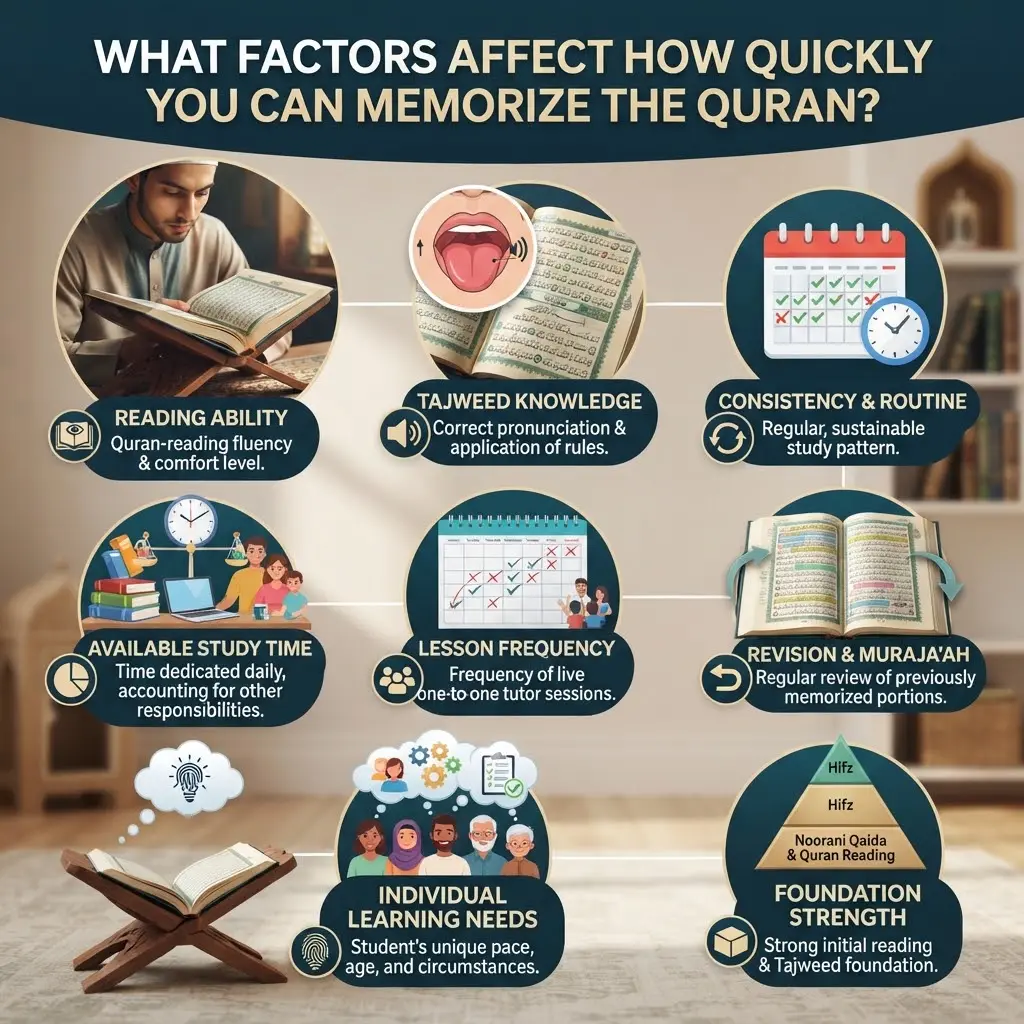
What Factors Affect How Quickly You Can Memorize the Quran?
The speed of Quran memorization is influenced by several factors, including reading ability, Tajweed, consistency, available study time, lesson frequency, revision, and the student’s individual learning needs. These factors often matter more than simply asking whether a learner is a child or an adult.
A student who already reads the Quran comfortably may be able to focus more directly on memorization. Someone who is still developing basic reading skills may need additional Quran Reading instruction before establishing a larger Hifz routine. Likewise, learning correct pronunciation can affect how confidently a student memorizes new passages.
Daily practice is another important factor. Memorization generally requires repetition beyond the live lesson, so families should consider when the student can realistically practice. A child may have a suitable window after school, while an adult might prefer a consistent time before work or later in the evening.
Quran Reading and Tajweed Foundation
A strong Quran-reading foundation can make memorization more manageable. Tajweed, the rules governing correct Quran pronunciation, is also important because students should learn to recite the verses accurately rather than repeatedly memorizing pronunciation mistakes.
Daily Practice and Consistency
There is no universal number of verses or pages that every student should memorize each day. A tutor can help determine a suitable amount based on the student’s level and retention, while regular practice helps turn individual lessons into a consistent Quran memorization routine.
How Do Online Quran Memorization Classes Work?
Online Quran memorization classes typically combine live tutor instruction, new memorization, recitation correction, and regular revision. In a one-to-one class, the tutor can listen directly to the student and adjust the lesson according to the learner’s current needs.
A typical lesson may begin with Muraja’ah, or revision of previously memorized passages. The tutor may then introduce new material, sometimes referred to as Sabak, and listen while the student recites it repeatedly. Pronunciation and Tajweed issues can be corrected during the process rather than left until later.
After the new passage has been established, the student needs an appropriate practice routine between lessons. Future sessions can then revisit both recent and older memorization. This creates a cycle of learning, reciting, correcting, and reviewing rather than treating each lesson as an isolated activity.
For families, the tutor’s approach matters as much as the technology. Rattil Online provides one-to-one instruction with qualified and certified native Arab tutors, with both male and female tutors available. The academy has more than 10 years of experience in online Quran education, while individual student needs remain an important part of planning lessons.
The best way to understand whether this teaching style suits you or your child is to experience it directly. A Free Trial Class provides an opportunity to see how the tutor communicates, how the lesson is structured, and whether the learning environment feels appropriate before making a longer-term decision.
Is Online Quran Memorization Suitable for Children and Adults?
Online Quran memorization can suit both children and adults when the teaching approach, schedule, and expectations are appropriate for the individual learner. The key is not simply age, but whether the student has the support and routine needed to participate consistently.
Children and Teenagers
Children may benefit from focused lessons, clear instructions, encouragement, and parental support between classes. A quiet learning environment can make it easier for a child to participate without unnecessary distractions. Parents can also help by maintaining a regular practice time and communicating with the tutor when school commitments or other activities affect the routine.
Adult Learners
Adults may approach Hifz from very different starting points. Some may already read the Quran well, while others may first need support with basic reading or Tajweed. Adults also often need to fit learning around employment, university, parenting, or household responsibilities.
One-to-one online classes can be useful in these situations because lesson timing and pacing can be discussed around the student’s circumstances. Someone returning to Quran study does not need to compare their beginning with another learner’s progress. A gradual and consistent approach can provide a more realistic foundation.
For parents who want to know whether online learning will suit their child’s attention span, learning level, and schedule, many families find the easiest next step is to contact Rattil Online through WhatsApp and discuss those practical details before choosing a routine.
Do You Need Tajweed Before Starting Quran Memorization?
Students do not necessarily need advanced Tajweed knowledge before starting Quran memorization, but they should have sufficient Quran-reading ability to work toward accurate recitation. Tajweed can also be developed alongside Hifz when appropriate for the learner’s level.
For a beginner, trying to memorize passages before becoming comfortable with the Arabic letters and basic Quran reading can create unnecessary difficulty. A learner at this stage may benefit from Noorani Qaida or foundational Quran Reading lessons first.
Students who already read the Quran may have a different starting point. Their tutor can identify pronunciation issues and incorporate Tajweed instruction into memorization sessions. This approach can help prevent incorrect recitation from becoming embedded through repetition.
The goal is not to make every student complete the same prerequisites before Hifz. Instead, the starting point should reflect what the learner can already do. Quran memorization, Tajweed, and Quran Reading can sometimes develop together, while other students may benefit from strengthening one area before emphasizing another.
How Important Are Revision and Muraja’ah During Hifz?
Revision is a central part of Quran memorization because previously memorized passages need continued practice. A sustainable Hifz routine therefore includes both new memorization and Muraja’ah, rather than measuring progress only by how many new pages have been completed.
New Memorization vs. Revision
New memorization introduces additional Quran passages, while revision reinforces material learned previously. Both have an important place in a structured program. As the amount memorized grows, maintaining earlier portions can require increasing attention.
A tutor can listen to revision and notice where a student hesitates, forgets words, or needs pronunciation correction. Those passages can then receive additional attention rather than simply moving forward.
Building a Sustainable Quran Memorization Routine
A practical routine should account for the student’s entire week, not only the live class. School examinations, work deadlines, travel, illness, family events, and other responsibilities can temporarily change how much practice is realistic.
This does not mean progress has failed when a learner needs to slow down. Adjusting the pace can be a sensible part of long-term Quran memorization. Consistency, accurate recitation, and meaningful revision provide a stronger foundation than treating speed as the only measure of success.

Is Memorizing the Quran Online as Effective as Learning In Person?
Online and in-person Quran memorization can both provide valuable learning environments, and neither format is universally better for every student. The right choice depends on the learner’s needs, family circumstances, preferred learning environment, and quality of instruction.
Online Hifz can provide one-to-one attention, flexible scheduling, and access to qualified tutors when a suitable teacher is not easily available nearby. This can be particularly useful for families who live far from an Islamic institute or need lessons that fit around school and work.
In-person learning can offer a physical classroom, face-to-face interaction, and opportunities for local community participation. For some students, being physically present in a learning environment may help establish a routine.
The important comparison is therefore not simply “online versus in person.” Families should ask who will teach the student, how recitation will be corrected, how revision will be handled, whether the schedule is sustainable, and whether the learning environment suits the student.
Online Quran education is best viewed as an accessible option alongside other forms of Quran learning, rather than as a replacement for every local educational setting.
How Can You Fit Quran Memorization Around School, Work, or Family Life?
Quran memorization can be fitted around school, work, or family life by establishing a realistic class schedule and protecting a consistent period for personal practice and revision. The most suitable routine will depend on the student’s daily responsibilities.
For children, families may find it practical to schedule classes around school, homework, meals, and sleep. For adults, early mornings, evenings, or other predictable periods may work better depending on employment and family commitments.
Online learning can make scheduling more flexible because students do not have to travel to a physical classroom. However, flexibility should not be confused with a lack of structure. A student still benefits from knowing when lessons take place and when new memorization and Muraja’ah will be practiced.
It can also help to review the routine periodically. A schedule that works during a school term may need adjustment during holidays, examinations, travel, or periods of increased work.
Rather than asking, “How much can we fit in?” families can ask, “What routine can this student realistically maintain?” That question often leads to more useful expectations for long-term Quran memorization.
How Do You Choose the Right Online Quran Memorization Program?
The right online Quran memorization program should provide qualified tutors, an appropriate teaching structure, clear expectations, regular revision, and a schedule that fits the student’s circumstances. Families should evaluate the actual learning experience rather than choosing an academy based only on promotional claims.
Before enrolling, consider asking:
- Who will teach the student?
- Are the tutors qualified or certified?
- Do the tutors have strong Quran and Tajweed teaching experience?
- Are native Arab tutors available?
- Is one-to-one instruction offered?
- How are pronunciation and Tajweed mistakes corrected?
- How is Muraja’ah incorporated?
- Can lessons fit around school or work?
- Is the course appropriate for the student’s current reading level?
- Can parents understand how progress is monitored?
At Rattil Online, Quran education is delivered through qualified and certified native Arab tutors, with male and female tutors available. The academy’s more than 10 years of experience provides an established background for families considering online Quran education, while the student’s individual starting level and needs remain central to the learning process.
Real testimonials can also be useful when they are genuine and verifiable. However, a testimonial should complement—not replace—questions about tutor qualifications, course structure, and whether the program is suitable for the particular student.
How Can You Start Memorizing the Quran Online?
Starting Quran memorization online usually begins with understanding the student’s current Quran-reading ability, identifying any Tajweed or foundational needs, discussing goals and availability, and establishing a suitable learning routine. A trial lesson can then help determine whether the tutor and format are a good fit.
A practical starting process may look like this:
- Assess the student’s current Quran-reading level.
- Identify whether Noorani Qaida or Tajweed support is needed.
- Discuss the student’s Hifz goals and available study time.
- Choose an appropriate tutor and lesson schedule.
- Experience a live class.
- Establish a balanced routine for new memorization and Muraja’ah.
There is no need to know the exact number of months or years the journey will take before beginning. A more useful starting point is understanding where the learner is now and what kind of routine can realistically be maintained.
For students who may eventually pursue Quran Ijazah certification, this pathway should be discussed separately, as Ijazah involves specific certification arrangements and, where applicable, study with a qualified Sheikh through a recognized Sanad chain. Completing Quran memorization alone should not automatically be presented as an Ijazah program or certification.
Conclusion
Quran memorization is a personal journey, and how long does it take to memorize the Quran online cannot be answered responsibly with one fixed timeline. The pace depends on reading ability, Tajweed, daily practice, revision, lesson frequency, consistency, and the student’s individual circumstances.
For some learners, Hifz will become a focused part of their daily routine; for others, it may develop gradually alongside school, work, parenting, or other responsibilities. What matters is creating a learning pattern that supports accurate recitation and meaningful retention without turning memorization into a race.
Rattil Online supports this process through one-to-one online instruction with qualified and certified native Arab tutors, male and female tutor options, and more than 10 years of experience in Quran education. Picture a student gradually becoming more comfortable with each new passage, reciting what they have learned with greater familiarity, and building a Quran routine that fits naturally into everyday life. If that is the kind of journey you are hoping to begin, explore Rattil Online’s Quran Memorization Course and find a starting point suited to your learning needs.
Frequently Asked Questions
How long does it take to memorize the Quran online?
The time required to memorize the Quran online varies according to Quran-reading ability, daily practice, revision, lesson frequency, and individual learning pace. Some learners follow a more intensive routine, while others progress gradually alongside school, work, or family responsibilities. Accurate recitation and long-term retention should remain important priorities.
Can adults memorize the Quran through online Hifz classes?
Adults can learn Quran memorization through online Hifz classes when the schedule and learning pace fit their responsibilities. One-to-one instruction can allow the tutor to adapt lessons to an adult student's current Quran-reading level, available study time, and memorization goals while accommodating work, family, or other commitments.
Is online Quran memorization suitable for children?
Online Quran memorization can be suitable for children when the lesson format, tutor approach, and schedule match the child's age and learning needs. One-to-one classes can provide individualized attention, while parents can support progress by creating a quiet learning environment, encouraging regular practice, and maintaining a consistent routine.
Do I need to know Tajweed before starting Quran memorization?
Students do not necessarily need advanced Tajweed knowledge before beginning Quran memorization, but accurate Quran reading and pronunciation are important foundations. Students with limited reading skills may benefit from Noorani Qaida or Quran Reading lessons first, while learners with stronger foundations can develop Tajweed alongside their memorization when appropriate.
How much Quran should I memorize each day?
The amount of Quran a student should memorize each day depends on reading ability, retention, available time, age, and the overall learning routine. There is no universal daily page target suitable for everyone. A tutor can help establish a manageable amount that leaves sufficient time for repetition and Muraja'ah.
Is it better to memorize the Quran online or in person?
Online and in-person Quran memorization can both be suitable, depending on the student's needs and circumstances. Online Hifz offers flexibility and access to tutors without travel, while in-person learning can provide a physical classroom and local community environment. The quality of teaching, student preferences, schedule, and learning support are important considerations.
How important is revision during Quran memorization?
Revision is essential during Quran memorization because previously learned passages require regular reinforcement. Muraja'ah helps students revisit earlier memorization while continuing to learn new material. A balanced Hifz routine should therefore include both new passages and revision, with additional practice for portions that remain difficult or inconsistent.
Can I learn Quran memorization and Tajweed together?
Quran memorization and Tajweed can be studied together when the student's reading level supports that approach. Learning correct pronunciation while memorizing can help students practice passages accurately from the beginning. The balance between Tajweed, new memorization, and revision should be adjusted according to the learner's existing Quran-reading skills and needs.
Are online Quran memorization tutors certified?
Online Quran tutor qualifications vary between academies, so families should review the credentials and teaching background of prospective tutors. Rattil Online provides instruction through qualified and certified native Arab tutors, with male and female tutors available. Ijazah and Sanad-related qualifications should be discussed specifically when certification is part of a student's goals.
Can I try an online Quran memorization class before enrolling?
A trial lesson can help a student or parent evaluate the tutor's communication, lesson structure, teaching approach, and overall learning environment before making a longer-term commitment. Rattil Online offers a Free Trial Class so families and adult learners can experience the online format and discuss their Quran memorization needs.