

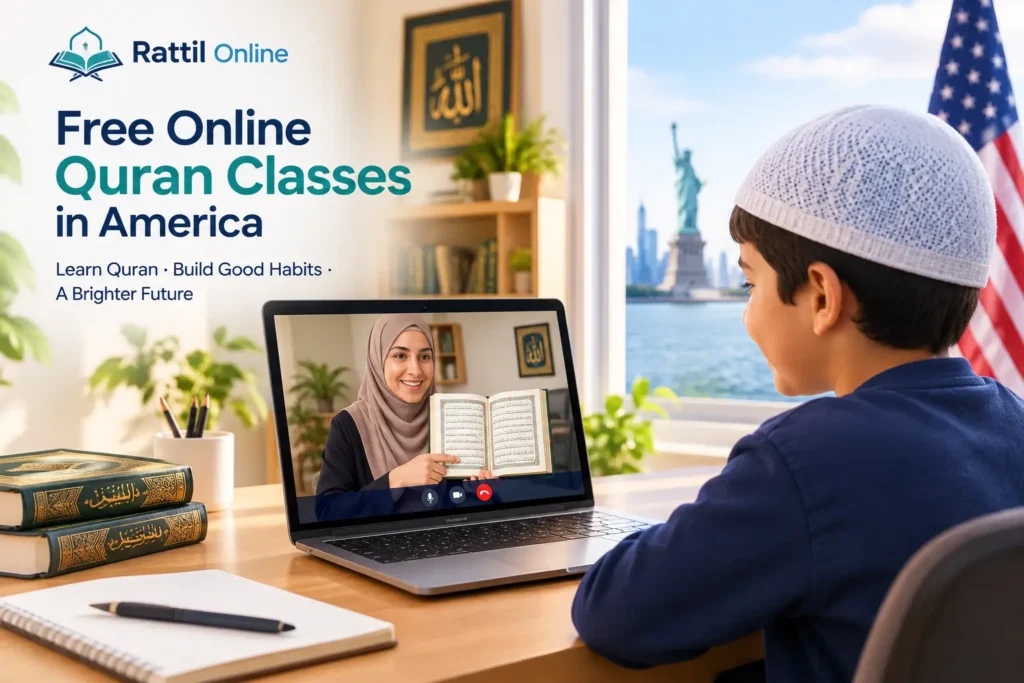
Free online Quran classes in America give children and adults an opportunity to begin learning Quran reading, Tajweed, memorization, or related Islamic subjects through online instruction, often through a free introductory or trial class. At Rattil Online, the free entry point is a trial lesson that allows students and parents to experience one-on-one learning with qualified native Arab tutors before deciding whether ongoing classes are suitable.
For many Muslim families in the United States, finding consistent Quran education can involve balancing school schedules, work, family responsibilities, transportation, and access to a suitable local teacher or Islamic school. Online learning can offer another practical option without requiring families to leave their local community or give up in-person Islamic education when it is available.
For parents, the more important question is not simply whether a class is free. It is whether the teacher is appropriately qualified, whether the teaching style suits the student, whether the schedule is manageable, and whether the course actually matches the learner’s needs. Adults returning to Quran study deserve the same thoughtful approach.
A free trial can therefore be useful as an opportunity to evaluate the experience rather than as a promise of a particular learning outcome.

What Are Free Online Quran Classes in America?
Learn Quran America programs generally refer to online Quran-learning opportunities that allow students in the United States to begin learning without an initial payment, most commonly through a free trial or introductory lesson. The meaning of “free” varies between providers, so families should always check whether an academy offers a trial class or genuinely free ongoing lessons.
At Rattil Online, the free opportunity is a free trial class, rather than a claim that the full curriculum is permanently free. This distinction matters because families searching for free Quran classes may otherwise expect unlimited instruction without tuition.
A trial gives a parent or adult learner a chance to understand how online Quran education works in practice. The student can meet the tutor, experience the lesson format, and discuss their current level and goals. Parents can also consider whether the teacher communicates clearly and whether the online environment seems comfortable for their child.
Online Quran education may cover several levels, from learning Arabic letters and the Noorani Qaida, a foundational resource commonly used to develop Quran reading skills, to Tajweed, Hifz, Arabic, and Islamic Studies.
How Do Online Quran Classes Work for Children and Adults?
Online Quran classes usually take place through live instruction, allowing the tutor and student to communicate directly, practice reading or recitation, and receive corrections during the lesson. The exact lesson structure depends on the student’s age, ability, course, and learning goals.
For beginners, lessons may begin with Arabic letters, sounds, joining letters, and basic reading through Noorani Qaida before progressing toward reading Quranic verses. A student who already reads Quran may instead begin with pronunciation assessment, Tajweed rules, or recitation practice.
One-on-one classes can be particularly useful when a learner needs individualized attention. Rather than waiting for other students to finish, the learner can spend more of the lesson practicing directly with the tutor. The tutor can also adjust explanations and exercises according to the student’s current level.
More advanced students may study Quran memorization, revision, Tajweed refinement, or an Ijazah pathway where the appropriate qualified teacher and Sanad chain are available.
This flexibility can benefit both children and adults. A parent may want structured lessons for a school-age child, while an adult beginner may prefer a private setting where there is room to ask questions without feeling embarrassed about starting from the basics.
Are Online Quran Teachers Qualified and Trustworthy?
Families choosing online Quran education should look for clearly stated tutor qualifications, relevant Quran-learning expertise, teaching experience, and a teaching approach suited to the student’s age and level. A teacher being available online does not by itself establish suitability, so parents should have enough information to make an informed choice.
Rattil Online has more than 10 years of experience providing online Quran and Islamic education and works with 15+ qualified and certified tutors. Its teaching team includes native Arab tutors, with male and female tutors available for students according to course and scheduling needs.
Native-speaker status can be relevant, particularly when accurate Arabic pronunciation and communication are important, but it should not be treated as a substitute for appropriate Quran teaching knowledge or certification.
Tutor-student compatibility is also worth considering, especially when choosing online Quran classes for adults in America. A technically qualified tutor may not have the communication style that works best for every learner. Adults may value a patient and supportive environment where they can ask questions, practice at their own pace, and revisit difficult Quran reading or Tajweed material as needed.
The free trial can help families evaluate these practical factors before committing to ongoing lessons. It should be viewed as an opportunity to assess fit, not as proof that one academy is automatically right for every student.
Are One-on-One Quran Classes Better Than Group Classes?
One-on-one Quran classes can provide more individualized attention than group lessons, but whether they are better depends on the student’s age, preferences, goals, and need for direct teacher feedback. Both formats can have a legitimate place in Quran education.
With private instruction, the tutor can focus on one learner’s reading, pronunciation, Tajweed, memorization, or questions. A student who needs additional repetition can spend more time on a particular skill, while a more advanced learner can move to appropriately challenging material.
One-on-one lessons can also make scheduling easier for families with demanding school or work routines. This can be particularly relevant in the United States, where children’s school days, extracurricular activities, and family commitments vary considerably.
Group learning has its own benefits. Children may enjoy learning alongside peers, and community-based Islamic schools can provide social interaction and a connection to a local Muslim community. A mosque or weekend Islamic school may also offer activities that an online private lesson cannot replicate.
For this reason, the choice does not have to be presented as online versus in-person in absolute terms. Some families may use online Quran classes as their primary format, while others may combine private online lessons with mosque attendance or weekend Islamic education.
Are Online Quran Classes Suitable for Kids in the USA?
Online Quran classes can be suitable for children when the tutor, lesson structure, schedule, and teaching approach are appropriate for the child’s age and current Quran level. Online learning is not automatically the right choice for every child, so families should consider how comfortably the child participates in a live online lesson.
Parents can look for an age-appropriate teaching style, patient correction, clear explanations, and a consistent lesson structure. A child who is just beginning may need more foundational reading practice, while a child who already reads Quran may benefit from Tajweed or memorization work.
The home environment also matters. A quiet place, reliable internet connection, and a regular lesson time can make it easier for a child to participate without unnecessary distractions.
Parents may also want to stay aware of their child’s progress and communicate with the academy when questions arise. One-on-one learning can make this easier because the tutor has more direct interaction with the individual student.
For American families, online classes can also reduce the need to travel after school or on weekends. However, families with convenient access to a local mosque or Islamic school do not need to view online education as a replacement. It can instead complement local Quran and Islamic education when that arrangement works best for the child.
What Do Online Quran Classes Teach?
Online Quran programs can cover foundational Quran reading through Tajweed, memorization, Ijazah study, Arabic language, and Islamic Studies, depending on the student’s level and selected course. A suitable starting point should be based on what the student can already do rather than simply their age.
Quran Reading and Noorani Qaida
Beginners can work on Arabic letters, sounds, letter combinations, pronunciation, and gradually reading Quranic words and verses. Noorani Qaida can provide a structured foundation before a learner moves into more sustained Quran reading.
Quran Recitation and Tajweed
Tajweed refers to the rules and principles used for correct Quran pronunciation and recitation. Lessons may involve practicing specific sounds, applying relevant rules, and receiving direct corrections while reading.
Quran Memorization and Hifz
Hifz means Quran memorization. Online Hifz lessons can include new memorization alongside regular revision. Memorization speed varies considerably between students, so a responsible program should avoid promising that every learner will complete a particular amount within a fixed period.
Quran Ijazah
Quran Ijazah is a certification pathway associated with demonstrating an appropriate level of Quran memorization and/or recitation under a qualified teacher. Requirements can vary according to the specific pathway. Where Ijazah is offered, students should understand the teacher’s qualifications and relevant Sanad chain rather than assuming that every Quran class leads to certification.
Arabic and Islamic Studies
Students may also study Arabic language, including grammar and literature at suitable levels, alongside foundational Islamic Studies. These subjects can support learners who want broader religious education in addition to Quran reading.
How Can Quran Classes Fit Around American School Schedules?
Online Quran classes America can make Quran education easier to fit around American school and family schedules because students can attend from home without traveling to a physical institute. The actual lesson times available depend on the academy’s current schedule and the student’s local USA time zone.
For children, families may consider after-school, evening, or weekend lessons while leaving enough time for homework, rest, extracurricular activities, and family commitments. A consistent schedule can make Quran study easier to maintain than repeatedly changing lesson times.
Time zones also matter because the United States covers multiple time zones. A schedule that works for a family on the East Coast may not be equally convenient for a family on the West Coast. Parents should therefore discuss their local time and preferred days before choosing an ongoing timetable.
This flexibility can be particularly helpful for diaspora families who live far from a mosque or Islamic center offering suitable Quran classes. It can also help families who already attend a local program but want additional individualized instruction.
Online learning does not need to replace local religious education. For families with good access to an Islamic school or mosque, it can simply provide another format when private instruction, scheduling flexibility, or access to a particular tutor is useful.

How Much Do Online Quran Classes Cost After a Free Trial?
The cost of online Quran classes depends on factors such as lesson frequency, duration, course type, class format, and the academy’s current pricing structure. Families should check the provider’s current fees rather than relying on general online Quran-class estimates.
When comparing prices, parents should consider what they are actually receiving. A useful comparison includes the number and length of lessons, whether classes are one-on-one, tutor qualifications, scheduling flexibility, course content, and any relevant cancellation or rescheduling policies.
The free trial is useful because it separates the decision into two stages. First, the family can determine whether the tutor and learning format are suitable. If the experience is positive, the family can then consider the ongoing course and its cost.
This approach can be more informative than choosing an academy based only on the lowest advertised price. For Quran education, the quality and suitability of instruction matter alongside affordability.
Rattil Online’s free trial is therefore best understood as an opportunity to experience the teaching format before deciding whether ongoing lessons are appropriate. Families should review the academy’s current pricing and course terms directly rather than assuming that a free trial means the complete program is free.
Are Online Quran Classes as Effective as Learning at a Mosque or Islamic School?
Online Quran classes and in-person Islamic education each offer different benefits, so neither format is automatically better for every student. The appropriate choice depends on the learner’s needs, local access, schedule, learning preferences, and the amount of individualized attention required.
Online lessons can offer convenience, no commuting, private instruction, and access to qualified tutors beyond the student’s immediate area. These features may be especially valuable when a family cannot find a suitable local class at a convenient time.
Mosques and Islamic schools, meanwhile, can provide community, peer interaction, in-person learning, and broader religious or social activities. For many families, these experiences are an important part of Muslim community life.
The two approaches can also work together. A child might attend a weekend Islamic school while receiving additional one-on-one Quran reading or Tajweed instruction online. An adult may attend mosque activities while using online lessons to develop Quran reading skills at a comfortable pace.
The most useful question is therefore not whether online learning is universally superior. It is whether a particular format, teacher, and schedule provide the kind of learning environment the student needs.
How Can I Start a Free Online Quran Trial Class?
To start a free online Quran trial class with Rattil Online, a parent or adult student can contact the academy through its available contact form or WhatsApp and provide basic information about the learner’s age, Quran level, preferred course, and scheduling needs.
Before the trial, it can help to identify what the student hopes to study. A complete beginner may need Quran reading and Noorani Qaida, while another learner may already read Quran and want to improve Tajweed. An experienced student may be interested in Hifz, revision, or an appropriate Ijazah pathway.
During the trial, parents can pay attention to how clearly the tutor explains concepts, whether corrections are understandable, whether the lesson matches the child’s level, and whether the child appears comfortable communicating with the teacher. Adult learners can similarly consider whether they feel able to ask questions and practice without pressure.
Afterward, families can review the course options, schedule, and current fees and decide whether continued study makes sense. There is no need to treat the trial as a commitment. Its purpose is to give the learner and family enough information to make a thoughtful decision.
Conclusion: Choosing the Right Online Quran Class in America
Choosing free online Quran classes in America is ultimately about more than finding a lesson that costs nothing. A useful starting point is a trial class that allows a student or parent to assess the tutor, teaching approach, course level, schedule, and overall fit before making a longer-term decision.
For beginners, that may mean starting with Quran reading and Noorani Qaida. For other learners, the right path may involve Tajweed, Hifz, Arabic, Islamic Studies, or an Ijazah pathway where the appropriate qualified teacher and Sanad chain are available. Children and adults may need different lesson structures, and families should feel comfortable asking questions before enrolling.
Rattil Online offers one-on-one online education with qualified and certified native Arab tutors, male and female teachers, and more than 10 years of experience serving international Muslim families. For families in America, the online format can provide a flexible option alongside local mosque or Islamic-school education.
A free trial can be a simple first step: experience the class, assess the fit, understand the available course, and then decide at your own pace.
Frequently Asked Questions
Free online Quran classes in America generally refer to opportunities to begin Quran education online without an initial payment, often through a free introductory or trial lesson. The exact meaning of “free” varies by academy, so families should confirm whether the offer is a single trial, introductory lesson, or ongoing free program.
Beginners can learn Quran reading online when lessons start at an appropriate level and include direct reading and pronunciation practice. Students may begin with Arabic letters and Noorani Qaida before progressing to Quranic words and verses. The pace varies according to previous experience, practice, and individual learning needs.
Online Quran classes can suit children when the tutor, lesson structure, duration, and schedule match the child's age and ability. One-on-one lessons provide direct opportunities for practice and correction, while parents should also consider whether their child is comfortable participating in a live online learning environment.
Online Quran classes can teach Tajweed through live recitation practice, pronunciation correction, and instruction in relevant rules. Students should look for teachers with suitable Quran-recitation knowledge and experience. The depth of Tajweed study can vary according to whether a learner is beginning, improving existing skills, or pursuing advanced recitation.
Online Quran teachers should have relevant Quran-learning and teaching qualifications appropriate to the subjects they teach. Rattil Online works with qualified and certified native Arab tutors, with male and female tutors available. Families should consider the tutor's relevant experience and qualifications for the specific course their child or adult learner intends to study.
Online Quran classes can often fit around American school schedules because students can learn from home without traveling to a physical institute. Families can discuss suitable times according to their local USA time zone, school commitments, and family routine. Actual scheduling options depend on the academy's current tutor availability.
The cost of online Quran classes after a free trial depends on lesson frequency, duration, course type, and class format. Families should review the academy's current pricing instead of relying on general estimates. A free trial allows parents or adult students to evaluate the teaching experience before deciding whether ongoing lessons are suitable.
Online Quran classes and mosque-based learning offer different benefits, so neither format is automatically more effective for every student. Online lessons can provide flexibility and individualized attention, while mosque and Islamic-school programs can provide community and group interaction. Families can also combine online Quran lessons with local Islamic education when that suits their needs.
Adults and reverts can take online Quran classes according to their current knowledge and learning goals. Beginners can start with Quran reading and foundational lessons, while more experienced students can study Tajweed, memorization, Arabic, or Islamic Studies. One-on-one instruction can also provide a private environment for asking questions and learning at a comfortable pace.
To start a free Quran trial class, a parent or adult student can contact Rattil Online through the available contact form or WhatsApp and provide the learner's age, Quran level, preferred course, and scheduling needs. The trial allows the family to experience the teaching approach and consider whether ongoing online Quran education is a suitable choice. What are free online Quran classes in America?
Can beginners learn to read the Quran online?
Are online Quran classes suitable for children?
Do online Quran classes teach Tajweed?
Are online Quran teachers qualified?
Can Quran classes fit around American school schedules?
How much do online Quran classes cost after the free trial?
Are online Quran classes as effective as mosque classes?
Can adults and reverts take online Quran classes?
How do I start a free Quran trial class?